Once you've identified weak indoor mobile signals as the persistent problem, the next step is choosing the right 4G signal booster for your property or vehicle.
The right choice depends on much more than coverage area alone. No matter whether you want better reception at home, in an office, a warehouse, a rural property, a car, or a boat, the outcome rests on your outdoor signal strength, the frequency bands the booster supports, your mobile operator, your building's layout, and the quality of the installation.
Not sure whether a booster is the right solution at all? Read our guide on whether 4G boosters really work before choosing a model. It compares the best 4G models available in the UK and explains which ones suit different environments. The model you need depends on the bands your operator uses in your location and your outdoor signal strength.
If you are looking for a mobile signal booster UK users can choose for a home, office, car or boat, the key is not only to compare coverage figures, but also to match the booster with your operator, supported frequency bands and real outdoor signal conditions.
And if you need personalised advice, MyAmplifiers managers will help you handpick the right Nikrans booster for your operator, location, and coverage requirements.
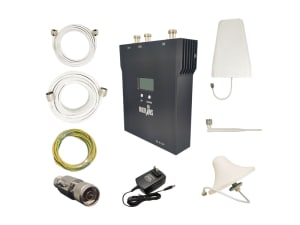
mobile signal booster Nikrans LCD-300GD
+ FREE Lightning Surge Protector
for United States
4.9/5 — 278 Reviews
How to Choose the Best 4G Signal Booster in the UK
A booster works best when it fits your specific conditions. Buying the most powerful model on the market rarely solves the problem on its own. Consider these factors before you choose:
Your mobile operator
Because EE, Vodafone, O2 and Three each use different frequency bands across the UK, your booster must support the ones your operator uses at the installation site.
Supported frequency bands
A booster strengthens only the frequency bands it supports. For example, if your operator runs 4G on a band the booster does not cover, you may not see much improvement. Some multi-band models support several frequencies, making them suitable for locations where operators use different bands.
Coverage area
Match the coverage to the size of your building. A small flat needs a smaller system than a detached house, office or warehouse. Remember that quoted figures are estimates, not a guarantee of what you will get in practice.
Building layout
Thick stone walls, reinforced concrete, metal structures, insulated glass, multiple floors and complex room layouts may reduce signal distribution. Larger buildings sometimes require additional indoor antennas or a higher-powered system.
Outdoor signal
A booster amplifies an existing outdoor signal. The stronger the signal received by the outdoor antenna, the better the potential indoor performance.
Calls, data and network compatibility
Think about how you will use the system. Some users only want more reliable voice calls. Others need stable 4G data for remote work or business. Certain multi-band boosters can improve 4G and 5G too, as long as the model supports the right frequency and your operator uses it where you are.
Browse our complete range of 4G signal boosters if you already know which type of system you need.
Top 4G Boosters for UK Homes
Home users experience poor 4G signals because walls, roofing materials, reinforced concrete and energy-efficient glazing reduce the mobile signal that reaches the building.
- For a small flat or compact home, a dual-band or tri-band booster may be enough if it supports the frequencies used by your operator in your area.
- In a medium-sized house, the choice depends on total coverage area, the number of rooms needing better reception, and how easily the signal passes through internal walls.
- For rural homes or properties where several operators are used, a multi-band model is more practical because it supports a wider range of frequencies.
- Large houses and estates make coverage planning more important. The position of the outdoor antenna, indoor antenna placement, wall materials, and installation quality can affect the result as much as the booster itself.
Most Appropriate 4G Boosters for Offices and Commercial Buildings
Businesses usually need more than a better signal in one room. Offices, shops, warehouses, hotels and workshops may have multiple users, operators, floors, thick walls or metal structures that affect indoor signal distribution.
- A small office or shop may only need a compact tri-band solution if the signal issue is limited to one area.
- A larger office can require wider designed coverage, especially if employees rely on stable 4G data for work calls, payment terminals, backup connectivity or daily communication.
- Warehouses, hotels and multi-floor commercial buildings need more careful antenna planning. In larger properties, layout often matters more than the coverage number on the box: walls, floors, and room count all shape how far the signal actually reaches.
First-Rate 4G Signal Boosters for Cars and Vehicles
Weak reception isn't only a problem at home — in a moving vehicle, metal panels and changing coverage areas make dropped calls and slow data even more common.
A vehicle booster is built for cars, vans, and camper vans. Instead of the antennas used in home or office systems, it uses vehicle-specific external and internal antennas to lift reception inside the cabin. It improves voice calls and mobile data while you're moving — as long as there's a usable signal outside and the booster supports your operator's frequency. What it can't do is create coverage where there's no network signal at all. On rural routes and longer trips, that frequency match matters most, since it's the difference between a booster that works and one that doesn't.
Explore our mobile signal booster for car range to compare current vehicle models before ordering.
Optimal 4G Signal Boosters for Boats
Weak mobile reception is common on boats because the cabin structure blocks the available outdoor signal. A marine booster refines reception inside the cabin if there is a usable mobile signal outside the vessel.
- For smaller boats and canal cruisers, a dual-band marine booster may be enough when the supported frequencies match the local network.
- On larger boats, or when you need broader frequency support, a multi-band marine booster can be the better choice.
Marine boosters are most effective in marinas, canals, rivers and coastal areas where mobile coverage already exists. They can’t create signals offshore beyond the reach of the mobile network.
Check out our mobile signal booster for the boat category to compare current marine models.
When to Choose a Multi-Band 4G Booster
A multi-band 4G booster is worth considering if several operators are used in the same building, if you are unsure which frequency is strongest, or if your location relies on different bands for calls and mobile data. Multi-band boosters support a wider range of frequencies than single- or dual-band models, but compatibility still depends on which bands your operator uses for 4G and/or 5G in your area. They are often a better fit for rural homes, shared buildings, offices and commercial spaces where signal conditions are more complex.
4G Booster Compatibility with UK Operators
The UK’s main mobile operators don't necessarily use the same frequency bands in every location. Before ordering, check that the system supports the frequency bands used by your operator where the booster will be installed.
Useful guides include:
If you use an MVNO, such as giffgaff, Tesco Mobile, VOXI or SMARTY, remember that these providers operate on one of the main UK networks. Compatibility should be checked against the underlying network, not only the brand name of your tariff.
Can a 4G Booster Also Help with 5G?
Some modern boosters support frequency bands that may also be used for 5G services. However, it is best not to assume that every 4G booster improves every 5G network. A booster can improve 4G and/or 5G if:
- The model supports the relevant frequency.
- Your operator uses that frequency for 5G in your area.
- There is sufficient outdoor signal to amplify.
- The antenna system is installed correctly.
If reliable 5G performance is one of your priorities, check whether the selected model supports the relevant frequency bands used by your operator in your location.
Comparison Table: Which 4G Booster Should You Choose?
| Model | Best for | Bands / Frequencies | Designed coverage | Why choose |
|---|---|---|---|---|
| Nikrans LCD-300GD | Flats and small homes | 900 / 1800 MHz | Up to 300 m² | Compact dual-band solution for supported voice and 4G frequencies |
| Nikrans BD-300GDW | Medium homes, shops and small offices | 900 / 1800 / 2100 MHz | Up to 300 m² | Tri-band option for users needing broader compatibility |
| Nikrans NS-300-Smart+5G | Homes, rural properties and offices | 700 / 800 / 900 / 1800 / 2100 / 2600 MHz | Up to 300 m² | Multi-band model for more complex frequency environments |
| Nikrans NS-600-Smart | Larger homes and offices | 800 / 900 / 1800 / 2100 / 2600 MHz | Up to 600 m² | Suitable for larger indoor layouts |
| Nikrans NS-2000-Smart | Large houses, offices and warehouses | 800 / 900 / 1800 / 2100 / 2600 MHz | Up to 2000 m² | Designed for extensive indoor coverage |
| Nikrans NS-2000-Smart+5G | Large commercial buildings and complex installations | 700 / 800 / 900 / 1800 / 2100 / 2600 MHz | Up to 2000 m² | Broad frequency support for demanding environments |
| Nikrans LCD-GL-Drive | Cars, vans and camper vans | 800 / 900 MHz | Up to 150-200 m² | Dedicated vehicle solution |
| Nikrans LCD-GD-Boats | Boats | 900 / 1800 MHz | Up to 1000 m² | Marine booster for coastal and inland waters |
Note that actual coverage depends on outdoor signal strength, antenna placement, indoor layout, wall materials, system power and installation quality.
Why Buy from MyAmplifiers?
The right booster is not simply the one with the largest coverage area. It is the one that matches your operator, your location, your type of building, and the frequencies you rely on. That is what we help you get right at MyAmplifiers. Order with us and you will benefit from:
- High-quality Nikrans mobile signal boosters
- CE- and -RoHS certified solutions
- 3-year warranty
- DIY-friendly installation
- Complete installation kits
- Support by chat and email
- Expert help selecting the correct model
- Assistance with frequency and operator compatibility
Find the Right 4G Booster for Your Needs
Whether you are looking to improve signal at home, in the office, on the road or on the water, handpicking the right booster starts with understanding your operator, coverage requirements and supported frequency bands.
For reliable options, explore our full range of 4G signal boosters. And if you need personalised advice, contact MyAmplifiers now or use the Helper tool to find the most suitable Nikrans model for your location.
Frequently Asked Questions
Will one booster work with EE, Vodafone, O2 and Three?
Not necessarily. A booster only supports the frequency bands it is designed to amplify. Compatibility depends on which bands your operator uses in your location.
Can a 4G booster improve 5G?
Possibly. A booster can improve 4G and/or 5G if it supports the relevant frequency bands and your operator uses those frequencies for 5G services in your area.
Can I use a boat booster offshore?
Boat boosters can improve reception if there is a usable mobile signal, such as marinas, rivers and coastal areas. They can’t create coverage where no mobile network signal exists.
How much coverage can a booster provide?
Some systems are built for areas up to 300 m², while larger models can cover buildings up to 2000 m². What you get depends on the outdoor signal strength, where you place the antenna, your indoor layout, and the materials the building is made of.