The connection failing at a critical moment causes issues. It doesn’t matter what you’re doing — whether you’re browsing web pages, participating in a video conference, or just having an important call — poor mobile reception can ruin your whole day.
If your phone tends to lose connectivity, the problem isn't always your handset. Common mobile signal problems can be caused by your location, mobile network characteristics, interference from buildings, or overloaded cell towers. In many cases, the problem can be resolved with simple methods.
In the article below, we will discuss the most common reasons why your phone keeps dropping signal in 2026, how to diagnose the problem, and in which cases fixes such as Wi-Fi Calling or a mobile signal booster can help. By the end of the article, you will have a better understanding of what is causing the problem and which solution will be best suited for your home, office, car, or other location.
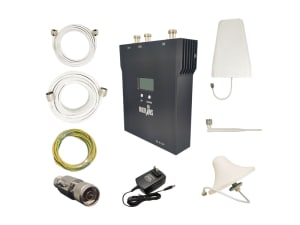
mobile signal booster Nikrans LCD-300GD
+ FREE Lightning Surge Protector
for United States
4.9/5 — 278 Reviews
How Has UK Mobile Signal Changed by 2026?
Mobile networks in the UK continue to evolve, and several industry changes have affected how phones connect to cellular services.
Mobile telecommunications are currently experiencing one of the most significant transitions — the end of 3G. Modern smartphones are forced to use only 4G/5G, or sometimes 2G, for calls and data transmission, since British mobile operators have stopped supporting 3G. Despite the fact that 2G is still used for some services, carriers plan to phase out these networks in the coming years. As a result, it may turn out that your phone won’t work if it doesn’t support VoLTE (voice over LTE) or uses an outdated SIM card.
Coverage has generally improved in many parts of the country, but availability still varies by operator and location. According to Ofcom, reliable 4G reception from all UK carriers now reaches around 84% of the UK's territory, and 5G coverage continues to expand. However, indoor signals often fail to match the stable performance of outdoor connectivity.
If weak indoor coverage is affecting your daily use, you may find our guide on how to boost 4G signal indoors helpful before considering other solutions. Sometimes, a more long‑term remedy may be required to improve signal strength in-house.
Why You Keep Cutting Out in 2026
The reasons why mobile service may be disrupted can be broadly divided into two main groups: those related to the physical properties of electromagnetic waves and their distribution, and those arising from outdated or damaged mobile equipment. It is also necessary to take into account that in the same area, the networks of different operators don't function in the same way, resulting in uneven coverage. Determining the most probable cause allows you to save time and implement the most efficient solution.
Distance from the Nearest Mobile Mast
Your phone signal weakens the further you move from the nearest cell tower. Even within cities, signal levels can fluctuate greatly based on tower proximity and the specific layout of your carrier's network.
This is particularly noticeable in:
- rural communities
- coastal areas
- mountainous regions
- remote business parks
- villages with limited infrastructure
If your phone consistently loses signal outdoors as well as indoors, distance from the nearest mast may be contributing to the problem.
Thick Walls and Modern Building Materials
One of the most common reasons for poor mobile signal at home is the building itself.
Today's homes and commercial structures are designed to improve energy efficiency, but many construction materials block radio waves.
Signal loss is commonly caused by:
- reinforced concrete
- steel frames
- brick and stone walls
- foil-backed insulation
- Low-E windows
If signal strength increases very much outdoors or near a window, the building's materials may be attenuating the external signal. This explains why coverage can vary drastically between adjacent buildings, despite being served by the same mobile operator.
Vehicle Signal Blocking
Just like building supplies, the materials used to make cars, vans and other vehicles can also weaken the mobile signal that penetrates inside the cabin. The metal bodywork, heated windscreens and tinted windows act as barriers to radio waves.
If your phone works normally outside the vehicle but repeatedly loses signal while travelling, the car itself may be contributing to the problem.
Building Layout Matters
Even within the same property, reception can vary significantly from room to room. No signal in house? If you have good reception only near a window or upstairs, the building's layout may be weakening the incoming signal.
For example:
- upstairs rooms may receive a stronger signal than basements
- rooms facing the nearest mobile mast often have better reception
- internal rooms without external walls usually experience weaker coverage
- in lifts, stairwells, and underground parking lots, there is often no signal or it is very weak
Large commercial buildings can experience similar problems due to their size and construction.
Indoor 5G Limitations
Many people assume that 5G automatically provides stronger coverage than 4G. In fact, the quality of the connection indoors depends on the frequency bands that your operator uses in your region.
With their higher speed, high-frequency 5G signals face challenges in penetrating walls, unlike lower frequency signals. As a result, your phone may often switch from 5G to 4G or even lose connection in certain parts of the building. If your 5G signal keeps dropping to 4G indoors, this is not necessarily a sign that your phone is malfunctioning.
Network Congestion
Despite good signal quality, your connection can be affected if a lot of people are using the same cell tower.
Congestion often occurs:
- during commuting hours
- at sporting events
- in shopping centres
- at concerts and festivals
- in densely populated city centres
Although several bars of signal are displayed on the screen, mobile internet can operate slowly, buffering and communication interruptions are possible due to a temporary lack of network capacity.
If connection problems occur only at certain times of the day, the cause may be network congestion.
UK 3G Switch-Off and VoLTE
Since most UK operators have now retired their 3G networks, compatible 4G calling (VoLTE) has become increasingly important.
Older smartphones or legacy SIM cards that don’t fully support VoLTE may experience:
- failed calls
- unexpected disconnections
- reduced service availability
If your phone was purchased several years ago, check whether it supports VoLTE and whether the feature is enabled.
SIM or eSIM Problems
Given the network updates noted earlier, it's crucial to ensure that your SIM is compatible with the latest mobile services. Should your SIM card be several years old, your provider may advise a replacement to a newer version that supports current network capabilities.
However, even if your SIM card is up to date and meets modern requirements, problems such as connection drops and weak signals may still occur without proper installation, activation, and configuration of SIM/eSIM.
Outdated Software or Provider Settings
Mobile operators regularly release carrier settings that optimise how smartphones connect to their networks.
Running outdated software may affect:
- network stability
- VoLTE compatibility
- 4G Calling
- Wi-Fi Calling
- network handovers
Keeping both your phone's operating system and carrier settings up to date helps ensure the best possible compatibility with your provider's network.
Damaged Phone Antenna
If your phone has been dropped, exposed to water or repaired using non-original parts, the internal antenna system may have been damaged.
Signs of hardware-related signal problems include:
- consistently weaker reception than other phones on the same network
- signal loss regardless of location
- sudden deterioration after physical damage
Testing another handset with the same SIM card is often the quickest way to determine whether the phone itself is responsible.
Local Operator Coverage Differences
Not all UK mobile operators provide identical coverage in every location.
One network may offer excellent indoor reception while another struggles to maintain a stable connection in the same building.
Before assuming your phone is faulty, compare your operator's coverage with alternative networks and ask friends or colleagues using different providers about their experience in the same location.
If only one carrier goes through problems, the issue may relate to local network coverage rather than your device.

First Things to Try on Android or iPhone
Now that you know the possible cause of your poor signal, you can try to fix it without buying new equipment. Check out some troubleshooting tips.
Reboot Your Phone
A simple restart can resolve temporary software bugs and reconnect the device to the network. This basic approach, while effective, is often the most reliable for resolving weak signals.
Toggle Airplane Mode
Activating the airplane mode for 10‑15 seconds, followed by disconnection, causes the device to reconnect to the operator’s network. This method is effective when there is a signal, but the internet doesn't load pages and applications.
Check Your SIM Card or eSIM
Mistakes in the installation and settings of the SIM card or eSIM can cause an unstable reception of your phone, and it doesn't depend on the signal level. What can you do?
If you use a physical SIM card:
- switch off your phone
- remove the SIM
- inspect it for dirt or damage
- carefully reinsert it
If you have an eSIM, check whether the tariff plan is activated, and also make sure that the eSIM is set up correctly. You can also consult your service provider to verify your profile status.
Install Software and Carrier Updates
Phone manufacturers and mobile operators regularly release updates that improve network compatibility.
Make sure you have installed:
- the latest operating system updates
- the latest carrier settings
- firmware updates supplied by your manufacturer
These updates often improve VoLTE performance, call quality over Wi‑Fi, and overall network stability.
Reset Network Settings
Resetting network settings may resolve configuration issues if you recently changed carriers or updated your device.
Please note that this usually deletes saved Wi‑Fi passwords and Bluetooth pairing data, so you will have to reconnect.
Toggle Mobile Data
If your web connection fails even with bars present, try flipping the switch on your mobile data for a couple of seconds. This action instructs your device to refresh its network settings, which might restore your internet connection.
Check Your Data Allowance
Some apparent signal problems are actually caused by exhausted data allowances or speed restrictions imposed after reaching your monthly limit.
Log in to your operator's app or online account to confirm that mobile data is still available.
Is the Operator Coverage to Blame?
If possible, insert a SIM card from another mobile carrier into your phone.
If reception improves significantly, your original provider's coverage may be the main cause rather than the handset itself.
Similarly, placing your SIM card into another compatible phone can help determine whether the issue is related to the device.
Contact Your Mobile Operator
If none of these steps resolves the issue, your operator may be able to identify:
- temporary outages
- local maintenance work
- SIM provisioning problems
- VoLTE configuration issues
- account-related restrictions
Checking with your provider before purchasing new equipment can save unnecessary expense.
Table for Quick Diagnostics: Symptoms, Causes, and Treatment of a Poor Signal
So now you know about the possible reasons for poor signal reception on your phone and what to do about it. The table below summarizes all the information above, which will help you narrow down the possible reasons and decide where to start.
| Symptom | Likely cause | What to try first |
|---|---|---|
| Occasional signal loss | Building materials, distance from cell towers, network congestion, weather conditions, old device | Begin with the steps mentioned above for troubleshooting. |
| Signal works outside but not indoors | Construction materials or building layout | Move near a window, check your signal strength in dBm, try Wi-Fi Calling, then consider a signal booster. |
| There are signal bars but no mobile internet | Insufficient balance and/or data, network congestion, disabled data transfer, APN settings failure or temporary operator outage | Check your account for a negative balance or package expiration, restart your phone and/or mobile data, toggle Airplane Mode, see your internet settings, search for operator breakdowns. |
| Calls keep dropping | Lack of VoLTE, old SIM or wrong network settings | Enable VoLTE if available, update carrier settings and check your SIM card. |
| Poor signal only in a vehicle | Vehicle body shielding | Test your phone outside the vehicle. If reception improves, a mobile signal booster for car may help. |
| Signal problems on a boat | Signal blockage by metal hulls or fiberglass, distance from cell towers, electromagnetic interference from onboard electronics | Consider a marine signal booster. |
| One operator works better than another | Local coverage differences | Compare the coverage area of your carrier with those of other telecommunications providers. |
These simple checks will help you determine what the problem is: your phone, mobile operator or environment.

Calls via Wi-Fi vs a Signal Repeater
If your phone receives a signal consistently as you leave the building, then the problem is that the signal is getting weaker inside. This is especially true for modern homes and offices with energy-efficient building materials.
Simple ways to improve the signal will most likely not help you. The two most popular solutions in this case are to use Wi-Fi calls or install a mobile signal booster. However, to make the right choice directly for your situation, you need to understand the difference between both methods.
When Making Calls via Wi-Fi Is a Good Option
While Wi‑Fi calling, regular phone calls and messages are transmitted via a wireless internet connection, not through a cellular tower. For this purpose, the phone’s built-in dialer and a standard number are used, and your voice is converted into digital data packets that are sent over a Wi‑Fi router to the mobile network operator.
It can be a practical solution if:
- you have fast and reliable home broadband
- your mobile operator supports Wi-Fi Calling
- you mainly need to make and receive voice calls and SMS
- you spend most of your time within Wi-Fi coverage
For many families, making calls via Wi‑Fi is an easy way to stay connected when there’s a weak mobile signal indoors. However, this doesn’t always solve the problem. The quality of Wi‑Fi calls depends entirely on the stability and bandwidth of the network you’re connected to. If the Wi‑Fi is slow or intermittent, the call quality will deteriorate. This especially concerns the video calls which are usually not very stable. In addition, a Wi‑Fi connection is mandatory. If you move out of the network’s coverage area, the mobile signal will be interrupted or disappear.
When a Signal Booster May Be the Better Choice
A phone signal booster works differently from Wi-Fi Calling.
Rather than replacing the network with Wi-Fi, it captures an available outdoor signal, strengthens supported frequency bands and redistributes the improved coverage inside a building or vehicle. This allows mobile devices to connect to a stronger indoor network.
A booster may be worth considering when:
- your phone receives usable signal outdoors but struggles indoors
- several rooms have poor reception
- multiple people use the mobile network
- both calls and data are affected
- you want stronger mobile coverage without relying entirely on Wi-Fi
Unlike Wi-Fi Calling, a mobile phone signal booster can improve supported mobile services throughout the coverage area, provided there is sufficient outdoor signal available.
It's important to understand here that a booster doesn’t create a signal where none exists.
Coverage results vary depending on several factors, including:
- outdoor signal strength
- frequency bands used by your operator
- building materials
- indoor layout
- installation quality
- the booster model selected
- local network deployment
For this reason, no responsible manufacturer can guarantee identical results in every property.
Homes
Poor reception is particularly common in modern houses with insulated walls, Low-E glazing or basement rooms.
If your signal is good in the garden but weak indoors, a mobile signal booster for home may help strengthen supported mobile bands throughout the areas covered by the system.
Offices and Commercial Buildings
Bad indoor coverage isn't limited to homes. It can also affect offices, hotels, shopping centres, warehouses, hospitals, educational campuses and other large commercial buildings. In these locations, large floor areas, multiple internal walls and steel structures can weaken mobile signal before it reaches users’ phones.
Reliable connectivity is increasingly important for:
- customer calls
- remote working
- mobile payment terminals
- business messaging
- video conferencing
A mobile signal booster for the office can help improve indoor coverage for multiple users where outdoor signal is available.
Rural Properties Face Additional Challenges
In rural locations, buildings often combine two separate issues:
- greater distance from the nearest mobile mast
- construction materials that further weaken already limited outdoor signal
Consequently, users might notice a strong signal outside, while struggling with poor coverage inside. A mobile signal booster can resolve this by improving indoor connectivity.
Vehicles
Cars, motorhomes and commercial vehicles often block the incoming mobile signal with their metal bodywork.
If the connection improves steadily when you get out of the vehicle, the signal booster for cars can provide more stable communication during the ride.
Boats and Marine Use
Mobile reception can also become unreliable on boats, particularly when moving further from the shoreline.
Where outdoor signals are available, a mobile signal booster for boats helps strengthen supported frequency bands on board.
Need Help With Your Booster Choice?
Picking a mobile signal booster isn't just about getting the most powerful one. Whether it will work for you depends on your carrier, where you’re located, and which frequency bands are used in your area.
If you're looking for a 4G signal booster in the UK, don't worry about identifying which frequency bands you need. Our specialists will help you choose a suitable model.
Just provide:
- your mobile operator (such as EE, Vodafone, O2 or Three)
- your postcode or location
- whether the issue affects calls, 4G, 5G or all services
- the type of building or vehicle
- the approximate area you want to cover
Our team can recommend a suitable Nikrans solution based on your requirements.
All Nikrans boosters supplied by MyAmplifiers are:
- CE certified
- RoHS compliant
- backed by a 3-year warranty
- designed for DIY-friendly installation
- supported by expert assistance via chat, phone and email
Coverage always depends on the level of the external signal, the antenna’s location, the quality of the installation, and the chosen booster model. Need help getting started? Use our Helper Tool or contact MyAmplifiers team for personalised guidance before making a purchase.
Frequently Asked Questions
Why do I keep losing service inside?
Poor indoor signal is often caused by the building rather than the phone. Reinforced concrete, steel frames, low‑emission windows, thermal insulation, location in the basement — all of this can weaken the mobile signal before it reaches your device.
Why does my phone constantly switch from 5G to 4G?
Your phone will drop from 5G to 4G when the 5G signal becomes weak, especially indoors. This is normal behaviour and helps maintain a more stable connection. Building materials, distance from the mast and the frequency bands used by your operator can all affect whether 5G remains available.
What if my phone says “No Service” or “Emergency Calls Only”?
If your phone shows “No Service” or “Emergency Calls Only”, first restart the device, toggle Airplane Mode and check whether your SIM or eSIM is active. If the issue affects only your phone, test your SIM in another device or contact your operator. If several people nearby have the same problem, the cause may be a local outage or network maintenance.
Why do I have signal bars but no mobile internet?
Signal bars indicate that your phone can detect a mobile network, but they don't guarantee a fast data connection. Temporary network congestion, weak data bands, operator outages, incorrect APN settings or reaching your data allowance can all result in slow or unavailable mobile internet despite showing signal.
Can the UK 3G switch-off affect my phone?
Yes. Since most UK operators have retired their 3G networks, older phones that relied on 3G for voice services may experience connection problems. Check that your phone supports VoLTE (4G Calling) and that your SIM card is compatible with your operator's current network.
For more information, read our guide to the UK 3G network shutdown.
Why does my 5G signal disappear inside buildings?
Higher-frequency 5G signals generally don't penetrate buildings as effectively as lower-frequency mobile bands. As a result, your phone may want to switch to LF bands indoors to maintain a more reliable connection. If your operator transmits 5G on these bands - that's Ok. If no - your smartphone can switch to 4G or lose signal at all.
Should I use Wi-Fi Calling or a mobile signal booster?
Wi-Fi Calling is ideal if you have reliable broadband and mainly need voice calls while connected to Wi-Fi. A mobile signal booster may be a better solution when outdoor mobile signal is available but indoor coverage is weak, especially if several users need improved mobile calls and data across multiple rooms.
Can a mobile signal booster improve both calls and mobile data?
Yes, provided the selected booster supports the frequency bands your operator uses for those services in your location. Some models can improve voice calls as well as 4G and/or 5G performance, depending on the operator's network deployment, available outdoor signal and installation conditions.
Conclusion
If your phone keeps losing signal, the cause isn't always obvious. It could be your location, your building, temporary network congestion, your SIM card or changes to the UK's mobile networks following the 3G switch-off.
By working through the troubleshooting steps in this guide, you can often identify the source of the problem without replacing your phone. If the problem is low indoor reception and the signal is received normally outside, then for supported frequency bands a booster may be a more reliable solution.
If you're unsure which option is right for your property, contact the MyAmplifiers specialists. They can recommend a suitable Nikrans booster based on your operator, location and coverage requirements — helping you choose the right solution without the guesswork.