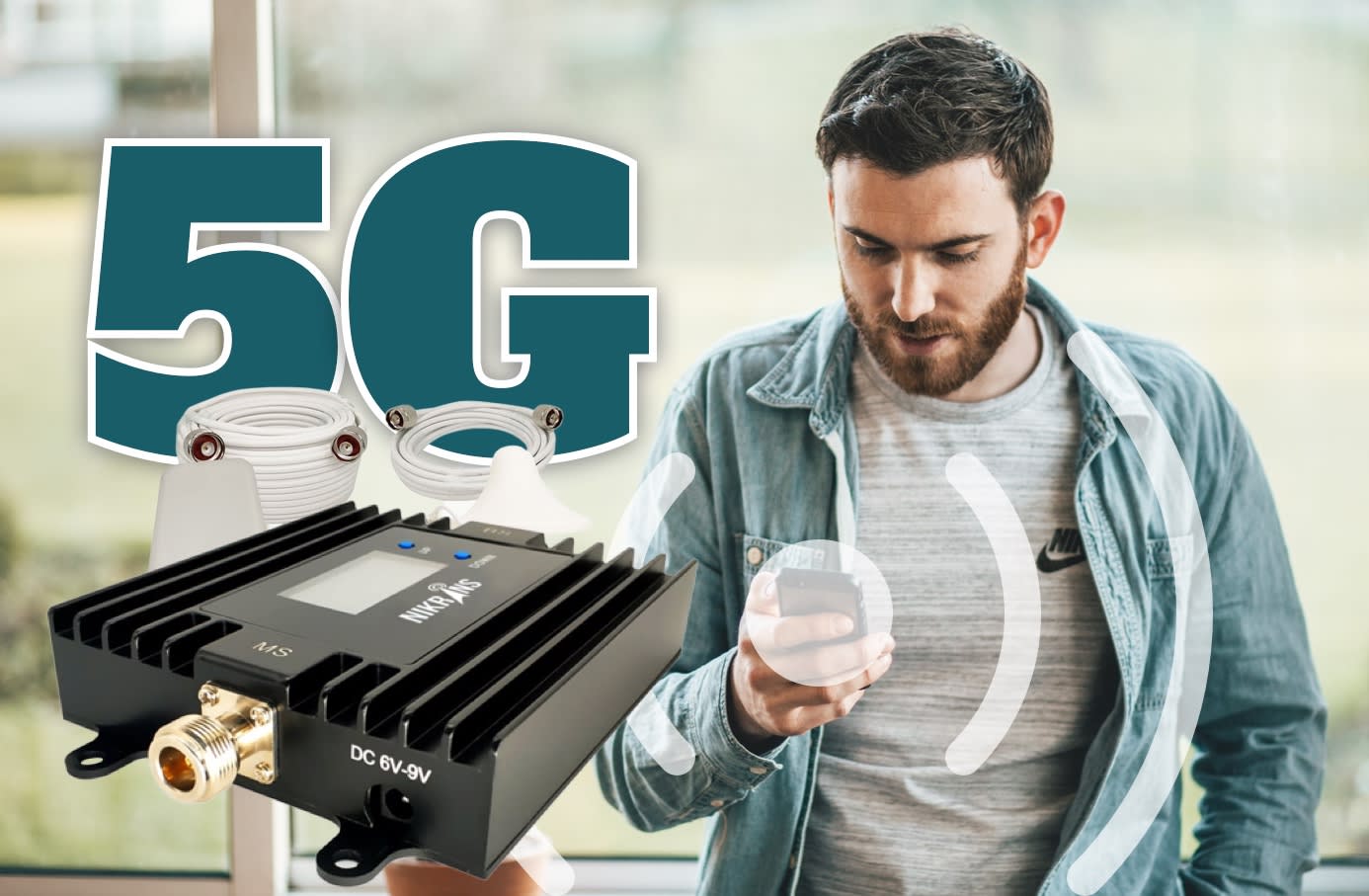
Even if your operator promises reliable 5G coverage, you may still experience weak 5G signal indoors. Weak signals are often less noticeable outdoors, but once you enter your home, office, parking lot, or garage, they can cause dropped connections, unstable speeds, or constant switching between 4G and 5G.
A 5G booster can amplify signal quality, but with certain conditions. It requires an external cellular signal and must be compatible with your provider's frequencies in your region. In general, the repeater amplifies both 5G and 4G, but it can't provide coverage in areas without an existing outdoor signal.
This guide tells you when a 5G signal booster is useful, why frequency compatibility is important, and how to pick the right model without getting stuck over frequency bands.
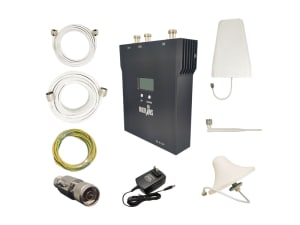
mobile signal booster Nikrans LCD-300GD
+ FREE Lightning Surge Protector
for United States
4.9/5 — 278 Reviews
Why Indoor 5G Signal Is Often Weak
Indoor 5G problems are very common, even in cities. The reason is simple: a mobile signal has to pass through walls, windows, insulation, and other materials before it reaches your phone.
Thick walls and modern building materials
Concrete, brick, metal structures, coated glass, and thermal insulation can all weaken mobile reception and lead to poor signals indoors. New buildings are often more energy-efficient, but the same materials may also block or reduce cellular reception.
This can affect both 4G and 5G. In some cases, higher 5G frequencies may be more sensitive to indoor signal loss than lower mobile bands.
Distance from the nearest cell tower
A distant cell tower means the external signal can weaken before reaching your building. Long distances involve more obstacles (walls, trees, foliage) and absorption by airborne water and precipitation. All this leads to low internet speeds, a break in connection or its complete lack.
Basement and ground-floor signal problems
You often come across weak mobile connections in basements, garages, warehouses, rooms with thick walls, etc. Your phone may show one bar, lose mobile internet, or constantly switch from 5G to 4G.
Why outdoor signal strength matters
A mobile signal booster does not generate new 5G coverage. It picks up the existing mobile signal, amplifies the supported frequencies and retransmits the signal indoors.
Results depend on outdoor signal quality, external antenna placement, building layout, cable length, supported bands, and installation quality.
What a 5G Booster Actually Does
You may be surprised, but a cellular repeater is not a single device. It is an entire system that includes two antennas (an outdoor and an indoor one) and a booster box.
The outdoor antenna gathers the radio waves from the operator's tower and sends them to the booster box. It converts these waves into a good signal which is then spread by the indoor antenna to the mobile devices inside a room.
This can make calls more stable and improve mobile internet on supported 4G and/or 5G bands.
Why boosters depend on supported frequency bands
The "5G Booster" designation does not ensure 5G compatibility across all frequencies and regions. That is why model selection matters. A booster must support the same frequencies your operator uses in your area.
Can a 4G Booster Improve 5G Signal?
Yes, in some cases. A 4G booster can improve indoor 5G signal if your operator uses the same frequency for 5G and the booster supports that band. The exact result depends on your operator, location, and repeater model.
When 4G and 5G work together
5G networks take advantage of existing 4G infrastructure. Your device can operate on both signals simultaneously, especially for maintaining coverage, ensuring stable connections, or enabling particular data transmissions.
In these cases, improving 4G signals can sometimes improve the overall mobile experience, including 5G-related performance.
DSS, LTE-assisted 5G, and supported bands
Some service providers employ Dynamic Spectrum Sharing, abbreviated as DSS, enabling simultaneous use of frequency resources by both 4G and 5G networks. Others opt for LTE-assisted 5G configurations.
This is why some products described as 5G boosters mainly amplify LTE frequencies that may also support parts of the operator’s 5G service.
Still, this does not mean every booster improves every 5G signal. Whether a device is suitable always depends on supported bands and local operator deployment.
Why some “5G boosters” mainly support LTE bands
Many contemporary boosters employ frequencies commonly used for 4G and, in some instances, 5G. However, they don't necessarily support all 5G NR bands automatically.
Before choosing a model, ask MyAmplifiers managers for help. Our specialists will assist you in selecting the suitable model, which fits with your provider, is tailored to your area, and delivers superior performance.
How to Check 5G Booster Compatibility
Choosing a booster is not just about buying its most powerful version. The right model must match your operator, location, and signal problem.
Operator frequencies and regional differences
Operators in the UK and Europe may use different bands for 4G and 5G. Even the frequency bands of the same carrier may vary depending on the region.
That means a booster suitable for one home may not be the best choice for another.
Supported bands in the UK and Europe
European operators employ frequency bands 700, 800, 900, 1800, 2100, 2600 MHz. Notably, recent additions include new 5G NR bands.
The exact frequencies used depend on the operator and local network infrastructure.
For most users, checking mobile frequency bands manually can be difficult. You can use the Helper tool to narrow down suitable models by country, operator and coverage area, or contact MyAmplifiers managers for help choosing your location-specific Nikrans booster.
Why model selection matters
A small flat, a detached house, an office, and a car all need different types of boosters.
The best choice depends on:
- supported frequency bands
- indoor area size
- outdoor signal level
- number of rooms
- building materials
- installation conditions
How to Choose the Right 5G Booster
Home vs office vs vehicle use
For home use, you will most likely need a booster with a small or medium coverage, sufficient for one or more rooms. Usually, all family members use the same operator, so a mono- or bi-band repeater should be enough for a household.
For offices, shops, or larger buildings, a wider-coverage system may be required. In premises serving other purposes besides housing, it can be necessary to strengthen the signals of multiple operators on various frequencies. In such buildings, you may need a multi-band booster.
For cars, trucks, vans, or mobile work stations, a vehicle booster is designed to maintain a stable signal while driving through areas with varying coverage.
Coverage area considerations
Coverage is not only about square metres. Thick walls, room layout, antenna placement, and outdoor signal strength all influence the final result.
A booster may cover a larger open space more easily than several small rooms separated by heavy walls.
Single-room vs multi-room systems
A single-room solution can be enough for a bedroom, office, or small apartment.
Larger homes and workplaces may need stronger systems or additional indoor antennas to distribute signal more evenly.
Outdoor antenna placement tips
The outdoor antenna should be placed where the signal is strongest, often near a window, balcony, roof, or outside wall.
For better results:
- avoid placing the antenna behind major obstacles
- keep enough distance between outdoor and indoor antennas
- follow the installation guide carefully
- reduce unnecessary cable length where possible
When a 5G Booster May Not Solve the Problem
A booster is useful in many situations, but it is not a magic fix.
Extremely weak outdoor signal
If there is almost no signal outside, the booster has practically nothing to amplify. In such cases, the results may be limited.
Poor installation conditions
Bad antenna placement, long cable runs, or incorrect setup can reduce performance. Installation quality is a major part of the final result.
Incorrect frequency support
If the booster does not support the frequency your operator uses in your area, it will not improve the signal. This is why checking compatibility before buying is so important.
Recommended 5G Booster Solutions
5G booster for home
A 5G booster for home can help if your phone works better outside than inside. It is suitable for users dealing with weak indoor mobile internet, dropped calls, or poor reception in specific rooms.
Office signal booster solutions
Offices often need wider coverage and more careful antenna planning. A suitable office system can help improve supported mobile signals for staff, visitors, and work devices.
Vehicle and travel boosters
A car signal booster can help drivers, mobile workers, and travellers in areas where mobile signal changes frequently. It is designed for use in cars, vans, campers, and similar vehicles.
Need Help Choosing the Right 5G Booster?
Not sure which model fits your operator and location? MyAmplifiers managers can help you choose a compatible solution based on your country, operator, building type, outdoor signal, and required coverage area.
You can also use the Helper tool to narrow down suitable options.
Nikrans boosters available at MyAmplifiers include CE and RoHS certified models, DIY-friendly installation, and a 3-year warranty.
FAQ
What is a 5G mobile signal booster?
A 5G booster is a device that captures an existing outdoor cellular signal, amplifies the supported mobile frequencies, and rebroadcasts the signal indoors.
Can a booster improve 5G signal indoors?
Yes, if there is an outdoor signal suitable for use and the booster supports the frequency bands used by your operator in your area.
Do 5G boosters work with all operators?
No, compatibility depends on operator frequencies, regional network deployment, and the booster model.
How do I know which 5G booster I need?
It depends on your operator, location, outdoor signal level and room area. You can contact MyAmplifiers managers for assistance.
Can a 4G booster also improve 5G?
Sometimes, yes. Some 5G services rely partly on LTE infrastructure or shared frequency resources. In these cases, improving supported 4G bands may also help the overall 5G experience.
Why is my 5G signal weak inside buildings?
Common reasons include thick walls, metal structures, coated windows, insulation, basement location, and distance from the tower.
Does a booster work without an outdoor signal?
No. A booster needs an existing outdoor signal to amplify. If there is no usable signal outside, the booster may not solve the problem.
What is the difference between a WiFi extender and a 5G booster?
A WiFi extender improves your local WiFi network. A 5G booster improves cellular signal from your mobile operator.