TL;DR / Quick Answer:
Homemade signal boosters (foil reflectors, wire antennas, paper clips) simply don't work – they offer negligible gain (0–1 dB), often make signal worse, and can interfere with emergency calls. Modern 4G/5G signals require precise RF engineering, multi-band support, and certified components – none of which a DIY project can deliver. This guide explains why DIY fails, walks you through the three essential components of a real booster (outdoor antenna, low-loss cable, amplifier), and shows you how to choose a certified CE/RoHS booster that actually improves coverage – without wasting hours on trial and error or risking legal issues.
👉 Click to learn why even a well-built homemade antenna can't beat a professional system – and what to do instead for reliable, whole-home coverage.
Everyone hates a weak cell phone signal. Having a cheap and easy fix, a DIY cell phone signal booster, is luring. But do homemade cell phone signal boosters work? Let’s separate facts from fiction and explore solutions that actually work and deliver results.
DIY temptation: why bother?
The overall idea of a DIY cell phone booster suggests a quick and cheap way to solve a nagging problem of low connectivity. People are searching for "how to make mobile signal booster at home" or "how to make a cell phone antenna" because they want to take control of their connections without shelling out a lot of money and refining their 4G/5G signals with just some basic materials.
Harsh truth about homemade boosters
Even if you find instructions on how to create a homemade signal booster, a solution like this won’t provide an improvement. The reasons are the following:
- Complexity of cellular signals: Boosting a cellular signal requires an understanding of radio frequency (RF) engineering, electromagnetic waves, and antenna designs.
- Precision required: Even minor impedance mismatches or a poorly designed antenna will degrade performance.
- Regulation compliance: In most regions, only CE- and RoHS-certified devices are permitted for use.
- Cable quality matters: Low-grade coaxial cables introduce losses of about 0.5–1 dB per meter. Over a 10-meter run, the signal can lose up to half of its strength before it even reaches the amplifier.
mobile signal booster Nikrans LCD-300GD
+ FREE Lightning Surge Protector
for United States
4.9/5 — 278 Reviews
How Professional Signal Boosters Actually Work
Understanding why DIY methods fail starts with knowing how a proper booster functions. Below are three essential components every reliable system features:
Outdoor antenna
It’s mounted on the roof to capture signals from your mobile operator's cell tower. A directional antenna, such as a Yagi or log-periodic model, offers higher gain when properly aligned. To aim it accurately, identify the nearest cell tower using NetMonitor or CellMapper. Tools like OpenSignal will provide crowd-sourced coverage maps to check signal strength.
Coaxial cable
The cable transmits the captured signal from the outdoor antenna to the amplifier unit. Standard RG-59 cable loses ~6 dB per 10 metres at 900 MHz, while premium LMR-400 loses only ~2 dB. For runs over 10 metres, try a low-loss cable that preserves signal strength. Use this cable loss calculator to compare options.
Amplifier unit and indoor antenna
The amplifier strengthens the signal and sends it back inside through an indoor antenna. To keep everything working without interference, make sure there’s at least 10 metres of vertical distance between the outdoor and indoor antennas. See our installation guide for best practices.
Why common DIY approaches fail
Homemade boosters don’t deliver any meaningful improvement. Independent testing by the Federal Communications Commission and Institute of Electrical and Electronics Engineers shows they’re ineffective and cause interference. At the same time, some DIY methods are still used, including:
The aluminum foil/cardboard reflector
Method: Shaping foil and cardboard into a directional reflector to focus signal toward the phone.
Reality: May concentrate the signal in one direction, but gain is negligible (<1 dB) and often blocked by walls or furniture.
The wire hanger or copper wire antenna
Method: Constructing a basic antenna from copper wire, connector blocks, and coaxial cable.
Reality: Homemade antennas are usually inefficient and interfere with your phone’s built-in antenna, making the signal worse. Antenna Theory resources explain why precision matters.
The "paper clip in the antenna hole" trick
Method: Inserting a straightened paper clip into the phone's external antenna port.
Reality: This risks damaging the phone's RF circuitry and provides no measurable gain. iFixit teardowns show why internal antenna design is complex.
Passive antenna setup (outdoor and indoor antenna, with no amplifier)
Method: Connecting two antennas with coaxial cable, claiming it "boosts" signal.
Reality: The principle of this installation is directed only to transmit the available signal, but not to boost it. If your phone shows 2 sticks outdoors, it won't show 5 sticks indoors — two is the maximum, often fewer due to cable loss.
An example of creating such an antenna
To build your own device for increasing the quality of a mobile signal, you will need to have:
- a piece of iron wire (35-40 cm)
- 2 connector blocks
- small bolt and nut
- 10 m of coaxial cable
- a piece of a water pipe
- a plastic container

Start by straightening the wire with pliers, then bend it in the center at a 90° angle. From that center point, measure about 9 cm on each side and make another 90° bend inward. Next, bend the ends of the wire inward as well, keeping about 8 cm from the previous bend.

Install the connector block on both ends of the wire and secure it with a screwdriver.

Saw one side of the pipe in half, and make a hole in the center on the other side. The hole should be of such size that the bolt could go though. After you insert the bolt into the hole, fix the antenna on top and secure it with a nut.

Next, you need to connect a coaxial cable. To do this, strip the end of the cable and separate the inner and outer wires. Connect the inner wire to one side of the small block, and outer wire to another.
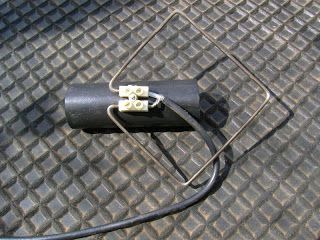
Place the self-made GSM antenna on your TV antenna in the same direction, and pull the cable into the house.

Strip the other end of the coaxial cable and again divide the wires inside it. At this time, you need to trim the external wires as they won't need them. Take a piece of plastic and cut it out of any desired shape. Make a small hole on one side, and pull the inner wire of the coaxial cable through it. You can strengthen this construction with tape. Well, now you can put the modem on this piece of plastic or attach the plastic to the back of the phone.

Real dangers and legal issues of DIY boosters
A homemade cell phone signal booster is dangerous because it:
- Interferes with emergency communications (999/112/911) and disrupts service for users.
- Violates telecommunications laws in the US (FCC), UK (Ofcom), Canada (ISED), EU, and Australia.
- Presents risks of electrical shock, fire, or damage to your mobile device if not handled properly.
- Voids manufacturer warranties.
High quality and safety of certified boosters is documented with CE and RoHS certificates. Numerous testimonials about professional products also point to their reliability.
Comparison: DIY vs. Certified Mobile Signal Booster
| Feature | Homemade DIY Booster | Certified Professional Booster |
|---|---|---|
| Signal gain | 0–1 dB, usually negligible | 50–70 dB (depending on model) |
| Coverage area | Unpredictable, often <1 m² | Up to 6500 ft² / 600 m² (depending on model) |
| Frequency support | Usually single-band and manually tuned | Multi-band: 5G/4G/2G automatic |
| Compliance | May violate telecom regulations if uncertified or improperly used | CE & RoHS certified; designed for safe network-compatible operation |
| Interference risk | High; may disrupt nearby networks or emergency calls | Low — automatic gain control and auto-shutdown help prevent interference |
| Installation time | Hours to days (trial and error) | Around 30–60 minutes, plug-and-play installation |
| Warranty & support | None | 3-year warranty plus expert technical support |
| Long-term reliability | Unstable and likely to degrade quickly | Engineered for 10+ years of operation |
UK Mobile Network Frequency Compatibility: Why Homemade DIY Boosters Fall Short
The overview below is based on current UK mobile network frequency data from Ofcom, GSMA Intelligence, and technical specifications published by Lycamobile, O2, EE, Three, and Vodafone. It explains why matching a UK network is not as simple as tuning one antenna: modern 4G and 5G coverage relies on multiple bands, which is why a certified mobile signal booster is a safer and more reliable choice than a homemade DIY setup.
| Network | Common UK frequency bands | What it means for a homemade DIY booster |
|---|---|---|
| 2G/GSM | 900 MHz, 1800 MHz | Not a future-proof target. 2G is legacy technology, and UK operators are expected to switch it off by 2033 at the latest. |
| 3G/UMTS | 2100 MHz | Not suitable for new booster projects. UK operators are already phasing out or have switched off 3G services. |
| 4G/LTE | Commonly 700, 800, 900, 1800, 2100 and 2600 MHz | Difficult to support with a homemade setup because UK operators use multiple bands depending on location, network load and coverage needs. |
| 5G NR | Low/mid bands such as 700, 1800, 2100, 2600 MHz, plus higher-capacity 5G bands | Very difficult for DIY solutions. 5G compatibility depends on precise frequency support, stable amplification and network-safe hardware. |
| Modern indoor coverage | Usually a mix of 4G and 5G bands | A single improvised antenna or homemade booster is unlikely to improve calls and mobile Internet reliably across a home or office. |
The overview below is based on current UK mobile network frequency data and technical information published by UK operators. It explains why a homemade DIY booster is unlikely to work reliably today: UK networks use multiple 4G and 5G bands, while 3G is being phased out and is no longer a future-proof option. That is why a certified mobile signal booster, selected for your operator and location, is a much safer choice. Read more about the 3G sunset.
Effective solutions: the smart choice
Forget the DIY network booster fantasies and use these proven alternatives:
- Contact your carrier to ask about coverage issues in your area and potential solutions they may offer (e.g., network extenders, Wi-Fi Calling).
- Optimise device placement in your home or office to find areas with stronger signals, for example, near windows.
- Use Wi-Fi Calling to make calls and send texts when the cellular signal is weak. Compare Wi-Fi Calling vs boosters.
- Install a certified signal booster to benefit from significant, reliable signal amplification.
For those struggling with metal buildings, resist the urge to create a "DIY mobile phone booster for metal building." Instead, opt for a professionally designed booster that's engineered to overcome the signal-blocking properties of metal structures (Faraday cage effect). DIY methods fail completely in metal structures.
Choose a signal booster correctly
- Determine the space you need to cover. Small flats may need 100–200 m² coverage, while larger homes or offices may require 300–500 m².
- Make sure that the booster supports the frequencies used by your carrier. Check compatibility with 5G if needed.
- Select higher-gain solutions (65–70 dB) for better amplification.
- Choose devices with CE, RoHS certificates.
- Get a device that prevents overload and interference by adjusting output based on input signal strength.
Don't Go It Alone — Get Guaranteed Results
If you aren't prepared to waste your personal time on DIY projects with unpredictable outcomes, you can purchase a reliable, certified device in just a few clicks. For instance, we recommend the Nikrans LCD-300GDW model — a universal solution for simultaneously boosting GSM, 4G, and 5G signals, holding both CE and RoHS certifications.
At MyAmplifiers, we provide a 3-year warranty on all our models. When you get a device from our website, you will achieve the desired results without having to lift a finger.
If you have any questions regarding our boosters, please don't hesitate to contact us — we would be happy to answer them!
FAQs
Do homemade mobile phone signal boosters really work?
In most cases, no. Homemade DIY boosters cannot reliably amplify modern 4G and 5G signals or support the right UK frequency bands. For real indoor coverage improvement, a certified mobile signal booster is a safer choice.
Can aluminum foil boost cell signal?
Minimally — and only in very specific lab conditions. In real homes, it usually blocks signals or creates interference.
What's the cheapest legal way to boost signals?
For whole-home coverage, a certified booster like the Nikrans LCD-300GDW is the most cost-effective long-term solution.
Do signal boosters work in metal buildings?
Yes — but only professional systems with outdoor antennas.
How to make a mobile signal booster antenna at home safely?
It is impossible to build a functional signal booster yourself at home. The only safe options are to use the Wi-Fi Calling feature free of charge or to purchase a mobile signal booster that complies with all regulatory requirements in your region.